About FAQ More Tools
Tire Size Calculator
Custom truck tires
Pistons & Ink · Free Tools

Tire Size
Calculator

Compare tire sizes, check your real speed vs speedometer reading, and find the right fit for your build. Supports P-Metric and inch formats.

P-Metric
& Inch
Live
Visual
Gear
Ratio helper
Current Tire
New Tire
Diameter diff
—
Speedo at 60mph
—
Size change
—
See Full Comparison ↓
Visual comparison
265/70R18
285/70R18
Current
New
Measurements
Spec Current New Difference
Diameter———
Width———
Sidewall height———
Circumference———
Revs per mile———
Speedometer error
Speedo reads Actual speed Error
Shop this size
285/70R18
Affiliate disclosure: the buttons above link to tire retailers. If you buy through them, Pistons & Ink may earn a commission at no extra cost to you. Prices and availability are set by each retailer.
Gear ratio & RPM helper
Optional — helps you find the right axle ratio for your new tire size
—
MPH (current tire)
—
MPH (new tire)
—
Recommended ratio for new tire

Reading a P-Metric size

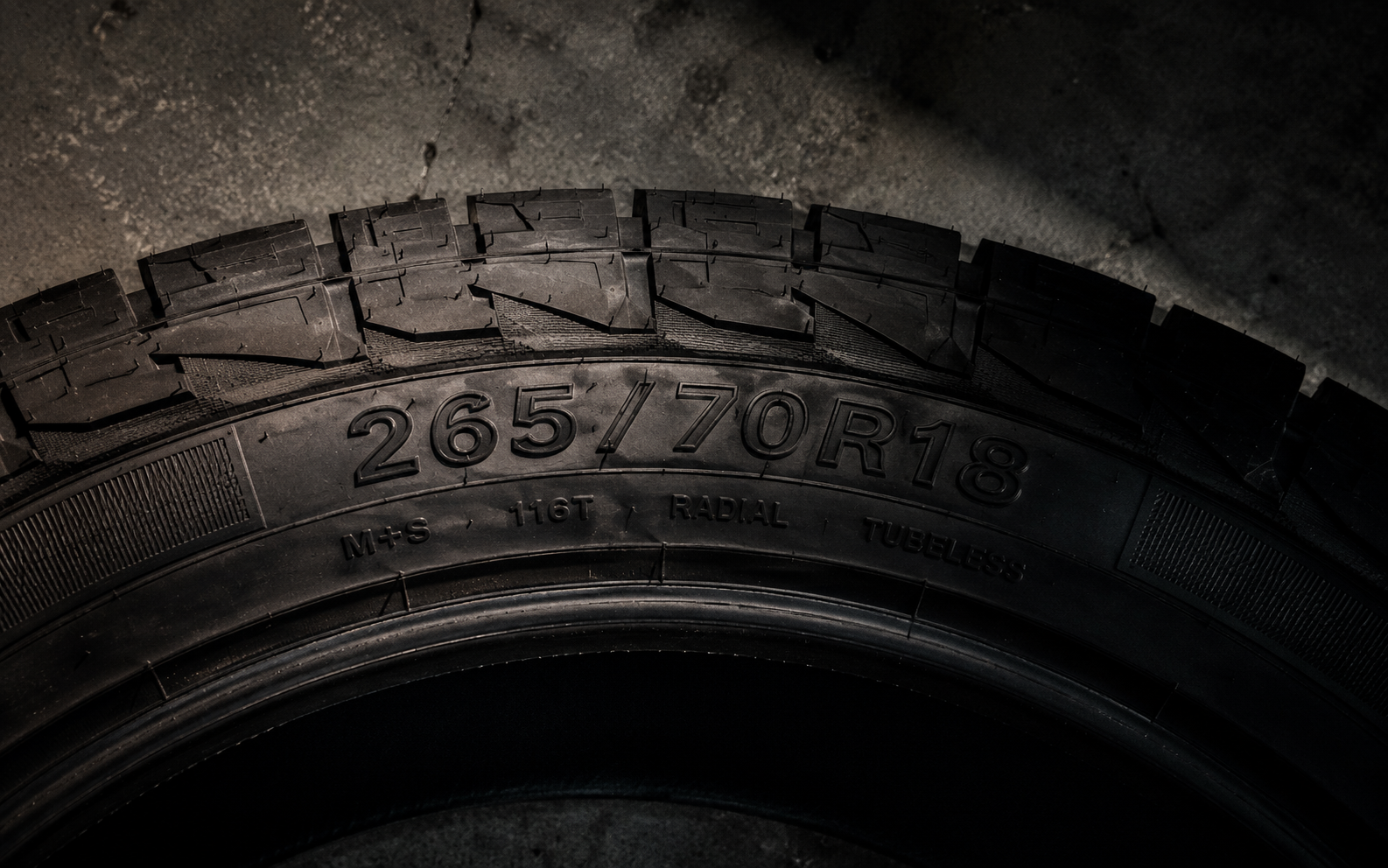
A size like 265/70R18 means: 265mm wide, 70% aspect ratio sidewall, R = radial, 18" rim. The sidewall height is width × aspect ÷ 100.

Reading an inch size

A size like 33×12.50R18 means: 33" overall diameter, 12.5" wide, 18" rim. Common on trucks and off-road rigs running larger aftermarket tires.

Why speedometer accuracy matters

A larger tire covers more ground per revolution. Your speedo reads low — you're going faster than it shows. Recalibrate your speedo or adjust your gear ratio to compensate.

P-Metric tire size markings
P-Metric Format
265/70R18
265
Section width in millimeters
/70
Aspect ratio — sidewall is 70% of the section width
R
Radial construction
18
Rim diameter in inches
Inch format off-road tire
Inch Format
33×12.50R18
33
Overall diameter in inches
12.5
Section width in inches
R
Radial construction
18
Rim diameter in inches
Common Tire Sizes
Lifted Trucks & SUVs
33×12.50R18 · 285/70R17 · 305/65R18
35×12.50R18 · 315/70R17 · 37×12.50R20
Custom & Classic
245/60R15 · 255/60R15 · 275/60R15
275/55R20 · 295/50R20 · 305/45R22
About This Calculator

What it does, and the math it runs

This calculator puts two tire sizes through the same geometry and reports everything that changes between them: diameter, width, sidewall height, circumference, revolutions per mile, speedometer error at real road speeds, and the gearing change that comes along for the ride. It starts by turning a size into a diameter. For a metric size, the sidewall is width × aspect ratio ÷ 25.4, and diameter = rim + two sidewalls. For an inch size, the diameter is printed right on the tire, and the sidewall is (diameter − rim) ÷ 2. From diameter, everything else is derived: circumference = π × diameter, revolutions per mile = 63,360 ÷ circumference (there are 63,360 inches in a mile), and your true speed at any speedometer reading = indicated speed × (new diameter ÷ old diameter).

The gear ratio helper closes the loop. Your recommended new axle ratio = current ratio × (new diameter ÷ old diameter), because gearing has to shrink the same proportion the tire grew. It also shows road speed at your chosen RPM for both sizes, using speed = RPM × diameter × π ÷ (axle ratio × transmission gear × 5,280). One honest limit: a sidewall marking is a nominal size, not a measurement. Two tires both labeled 285/70R18 can differ by a few tenths of an inch between brands, and a loaded tire's effective rolling diameter is slightly less than its unloaded one. The math here is exact for the size as labeled; for a final fitment call, compare it against the manufacturer's published diameter for the specific tire.

How to use it

  1. Set each panel's format, P-Metric or Inch, to match the size you are entering; the two panels can use different formats.
  2. Enter your current size on the left and the size you are considering on the right.
  3. Read the measurements table for the physical differences, then the speedometer table for what your dash will get wrong at each speed.
  4. Scroll to the gear ratio helper, enter your current axle ratio, a cruise RPM and the transmission gear, and read the recommended ratio that restores your current gearing feel.

Worked example

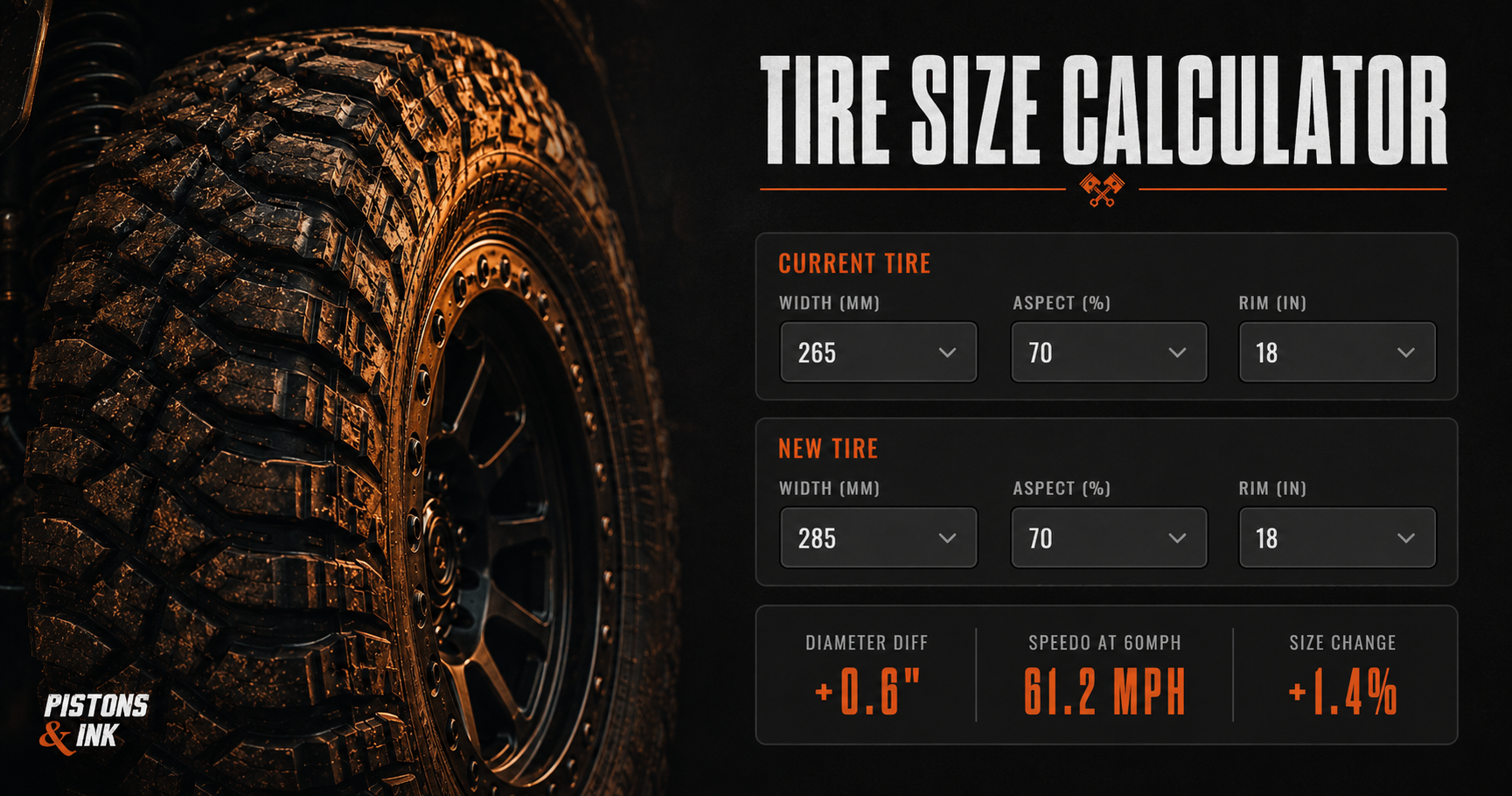
The page's default comparison, 265/70R18 to 285/70R18, is the classic one-size upgrade. The 265's sidewall is 265 × 0.70 ÷ 25.4 = 7.30 in, for a diameter of 32.61 in and a width of 10.43 in. The 285 grows the sidewall to 7.85 in, the diameter to 33.71 in and the width to 11.22 in: +1.10 in taller, +3.4%. Revolutions per mile fall from about 619 to about 598, and the speedometer error follows the diameter exactly: when the dash says 60 MPH you are actually doing 62.0 MPH. In the gear helper, restoring the stock feel from a 3.73 axle takes 3.73 × 1.034 = a 3.86 ratio, which is why most people leave the gears alone on a one-size bump and save the regear for 35s.
Frequently Asked Questions

Will bigger tires affect my speedometer?

Speedometer in custom truck

Yes. A larger tire covers more distance per revolution. Your speedometer is calibrated to your stock tire size, so going larger means your speedo reads lower than your actual speed. Use the speedometer correction table above to see exactly how much your specific size change affects your reading.

Do I need to regear after a tire size change?

Ring and pinion gear set

It depends on how much you're increasing. A one-size bump (e.g., 285 to 305) usually doesn't require regearing. Going up significantly — like from a 265 to a 35-inch tire — will affect acceleration, fuel economy, and transmission behavior noticeably. Use the gear ratio helper above to find your ideal new ratio.

What's the difference between P-Metric and inch sizing?

P-Metric (e.g., 265/70R18) is the standard format used on most passenger cars and light trucks — width in mm, aspect ratio as a percentage, and rim size in inches. Inch sizing (e.g., 33×12.50R18) is common on off-road and aftermarket tires — diameter first, then width, then rim, all in inches.

Will bigger tires fit without a lift?

It depends on your vehicle. Generally, adding 1–2" in diameter (half inch in radius) won't require a lift on most trucks, but you may need a leveling kit. Going to 33s on a stock truck typically needs a 2–3" lift. 35s usually require 3.5–4". Always check your specific make/model for clearance requirements.

How do I convert P-Metric to inches?

Diameter = rim size + (2 × sidewall height in inches). Sidewall = (width mm × aspect ratio ÷ 100) ÷ 25.4. Width in inches = width mm ÷ 25.4. This calculator handles the conversion automatically when you switch between formats.

What gear ratio should I run with 35s?

Most trucks running 35-inch tires are best served by a 4.10 or 4.56 gear ratio, depending on the engine and transmission. If you're coming from stock 31s with a 3.73 ratio, the gear ratio helper above will calculate your recommended new ratio automatically.

About Pistons & Ink

Built by enthusiasts,
for enthusiasts

Pistons & Ink is a digital product studio based in Ocala, Florida, building web and mobile products for the automotive enthusiast community. We come from the custom car and truck world — lowriders, minitrucks, C10s, restomods — and we build tools we'd use ourselves.

This tire calculator is one of 11 free tools in the Pistons & Ink Digital Toolbox, built for the aftermarket auto industry. If it helped you, the rest of the toolbox is right here.

Visit Pistons & Ink →
From the Guides Library
How to Read a Tire Size
Decode the sidewall code, work the diameter math by hand, and see what plus-sizing really does to your speedometer, gearing and clearance.
Read the Guide